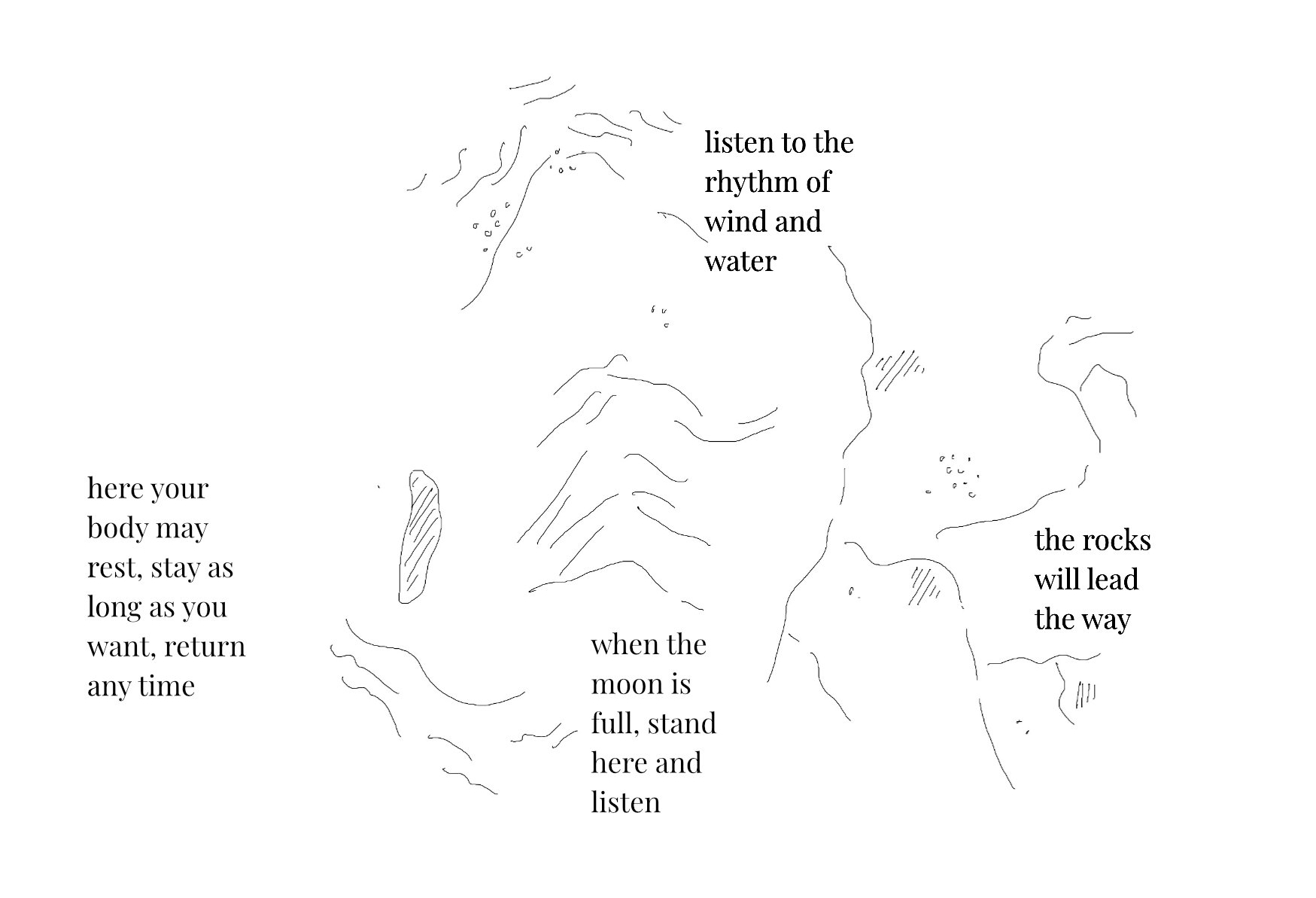
A line drawing on a white background. Thin, hand-drawn lines suggest currents, 
            stone contours, and gentle movement, with small dots and hatching marks indicating texture or sound-like traces. 
            Scattered around the drawing are short poetic text fragments: listen to the rhythm of wind and water, the rocks will lead the way,
            when the moon is full, stand here and listen, and here your body may rest, stay as long as you want, return any time.


Hrísey, Iceland

A Listening Companion


Kotoe Oana and Leah M. Bowie


This page accompanies a series of visual works and sound pieces developed in conversation.

The paintings were made by attuning to the landscape.

The sounds were made by listening to the rhythm of the island.

What follows are notes and scores that emerged from these processes. They are invitations, not instructions. Some pages offer attunement. Others offer a way to listen. You may take as much or as little of this as you wish.
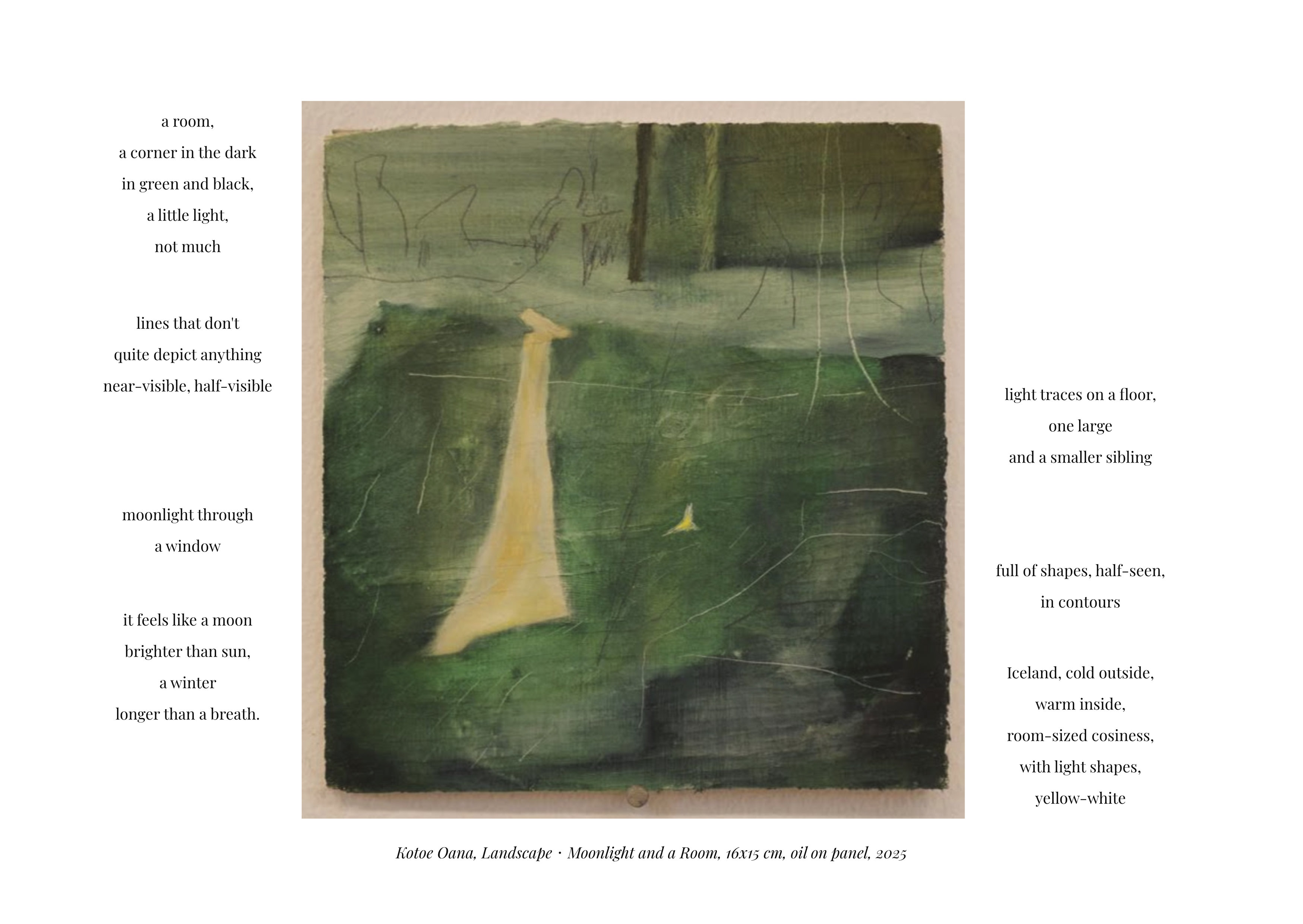
An abstract green-toned painting suggesting moonlight 
        in a dim room, with a partially visible window and two yellow light-shapes on the floor. The image is presented 
        with poetic listening notes on both sides, framing the artwork as a reflective, responsive piece.

        The listening notes printed on the left and right sides respond to the painting in poetic language. They describe 
        a dark green-and-black room with a small amount of light; lines that almost depict something but remain half-seen; 
        moonlight through a window; and a feeling of winter, stillness, and time stretched longer than a breath. The notes 
        reference light traces on the floor, one large and one smaller, shapes that feel half-visible and contour-like, 
        and an atmosphere of Icelandic cold outside contrasted with warmth and coziness inside. The text frames the 
        painting as a sensory, emotional, and interpretive experience rather than a literal scene.

        Below the image, a caption reads: Kotoe Oana, Landscape: Moonlight and a Room, 16x15 cm, oil on panel, 2025.

Listening Score

Begin in silence in a dark room.
Wait until the room feels present.

Introduce one sound only.
Keep the volume below the level of certainty.
Observe what the sound does to the room.

Allow your body to sway with the sound.
If the sound begins to feel stable, step back.

When the sound has drawn the shape of the moonlight,
let it recede.

Wait for the echo.
If there is an echo, let it appear and fade.
If an echo asks for a body, you may lend it your breath.

If nothing appears, allow that to be enough.

Stop before it feels complete.


Begins with a short spoken instruction that repeats the first two lines of the score, followed by silence. Room sound fades in gradually, then continues as quiet ambience. A few long cello notes enter, half a melody moving through the room, then silence. The piece ends with a voice humming an echo of the cello's half-melody.
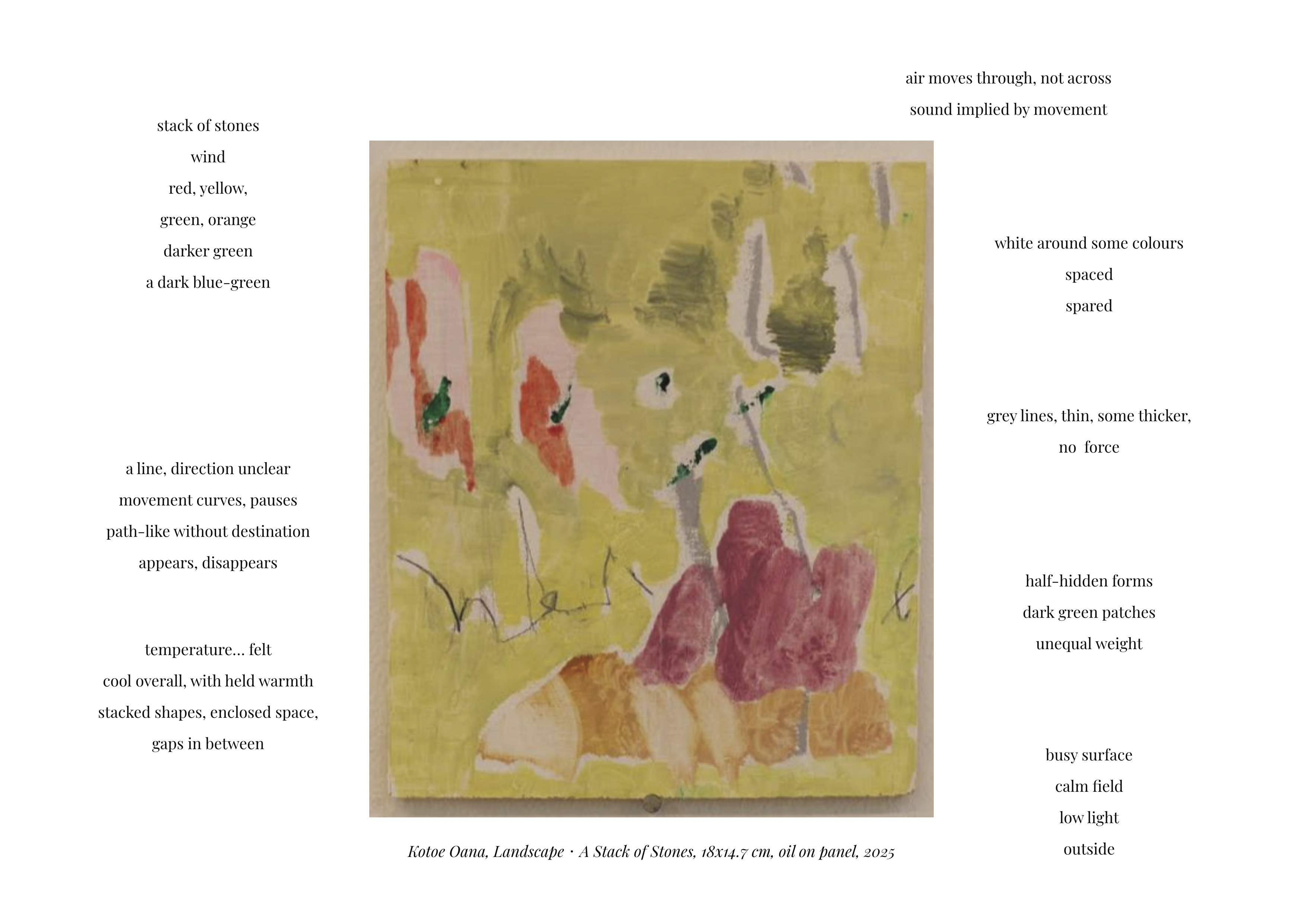
An abstract painting centered between two columns of poetic listening notes. 
        The painting depicts a loosely structured stack of stone-like forms against a soft yellow background. The surface is layered 
        with warm and cool tones, arranged in uneven, stacked shapes and lines that feel weighted but not rigid. Some forms appear 
        partially dissolved into the background.

        The listening notes printed on both sides of the painting respond to its sensory and emotional qualities. They describe a 
        stack of stones, wind, layered colors (red, yellow, green, orange, darker green, dark blue-green), and a sense of air moving 
        through rather than across the scene. The notes reference implied sound through movement, thin grey lines with no force, 
        half-hidden forms, unequal weight, and a path-like line without destination. They also describe temperature and atmosphere: 
        cool overall with warmth held, enclosed stacked shapes with gaps in between, a calm field beneath a busy surface, low light, 
        and a feeling of being outside.

        Below the image, a caption reads: Kotoe Oana, Landscape: A Stack of Stones, 18x14.7 cm, oil on panel, 2025.

Listening Score

The image itself is the listening score.
Dark marks embody possible listening positions.
The lines invite movement, breath, whisper.


Recorded using a self-made geophone placed in gravel. The sound consists of small stones shifting and scraping, created in response to a field recording of wind in Hrísey. The original wind is not audible, only the physical reply to it. The gravel movements rise and fall like a dialogue with an absent force. A second microphone was placed in the grass near the gravel, capturing ambient sounds of birds and the environment. Whispered words “gaps,” “lines,” “half-hidden”, appear as if spoken in a large, hollow space. The whispers repeat and linger as the stone sounds gradually fade.
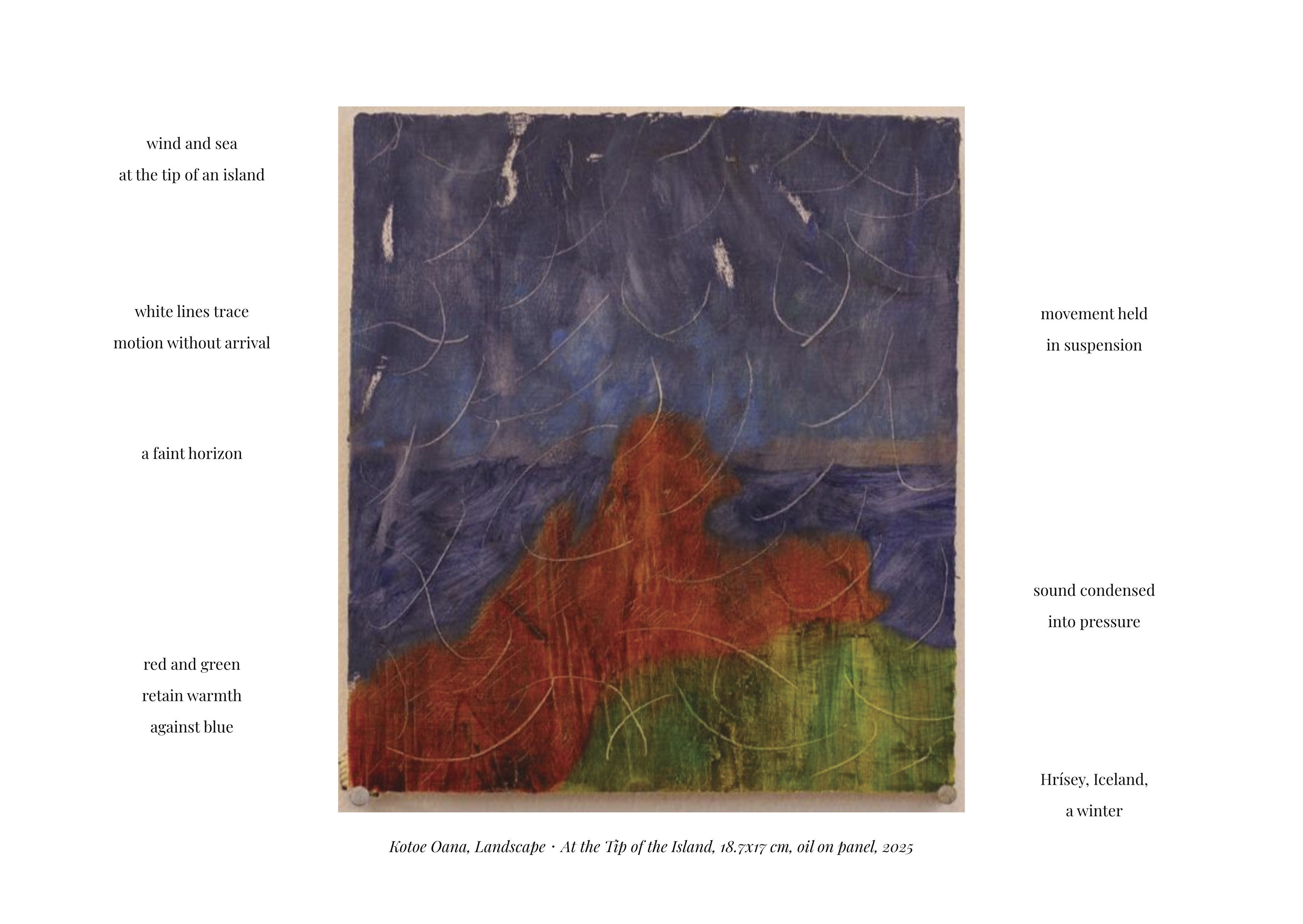
An abstract painting centered between two columns of poetic listening notes. The painting 
        depicts a coastal or island-like scene rendered in deep blues, reds, and greens. The upper portion is dominated by dark, 
        stormy blue tones, layered with soft circular arcs and thin white lines. A faint horizontal line near the middle hints at a 
        distant horizon separating sky and sea. Below it, dense red forms rise like a rocky outcrop, cliff, or landmass. Along the lower 
        edge, green areas appear like grass, moss, or shoreline terrain, creating a layered sense of land meeting water. The surface 
        shows scratches, etched lines, and textured brushwork, reinforcing a sense of weather and erosion.

        The listening notes printed on both sides of the painting respond to its atmosphere and sensory qualities. They reference wind 
        and sea at the tip of an island, white lines tracing motion without arrival, and a faint horizon. The notes describe red and 
        green retaining warmth against blue, movement held in suspension, sound condensed into pressure, and a winter atmosphere in 
        Hrísey, Iceland. Together, the text frames the painting as a scene of suspended motion, coastal weather, and quiet intensity, 
        where sound, wind, and temperature are felt as pressure rather than narrative.


        Below the image, a caption reads: Kotoe Oana, Landscape: At the Tip of the Island, 18.7x17 cm, oil on panel, 2025.

Listening Score

Begin in water.
Wait.

Notice the waves,
as if remembering them.

For each etched line,
offer one listening gesture.
Keep the gesture below the level of intention.

Let the sound travel through the water.
Leave space between gestures.

If a sound begins to feel stable, withdraw.
When sound has traced what wants to be traced,
let it recede.

Listen for what remains.

When the water quiets,
breathe with the wind.


Recorded using a hydrophone submerged in a bathtub. Recordings of ocean waves from Hrísey were played through a speaker in the water, forming a submerged field of motion. In response to the etched lines in the painting, metal implements were used to create sounds in the tub. These underwater tones ring, shimmer, and curve in pitch, at times resembling whale song. The piece carries an echo of humpback whales in Iceland, translating distant marine presence into a domestic space.


Notes on Listening

This companion presents three works by visual artist Kotoe Oana. It offers invitations for listening shaped in relation to these paintings. The paintings, listening notes, and sounds were developed during a residency in Hrísey, Iceland.

The work emerged through deliberate, embodied choices, through proximity, attunement, hesitation, and response.

The recordings arose from practices of sustained listening. Some sounds emerged through encounters with place, while others took form through perception and attentive listening. These sounds are traces of situated, intentional, and relational processes.


A PDF version of this companion is available here.